Security after hours is rarely a simple choice between a heavy shutter and nothing. We look at your stock, your glass and your Little Venice premises together, then specify what the risk calls for.
Your survey is where the price gets real, because widths, heights, levels and access are all taken on site in Little Venice.
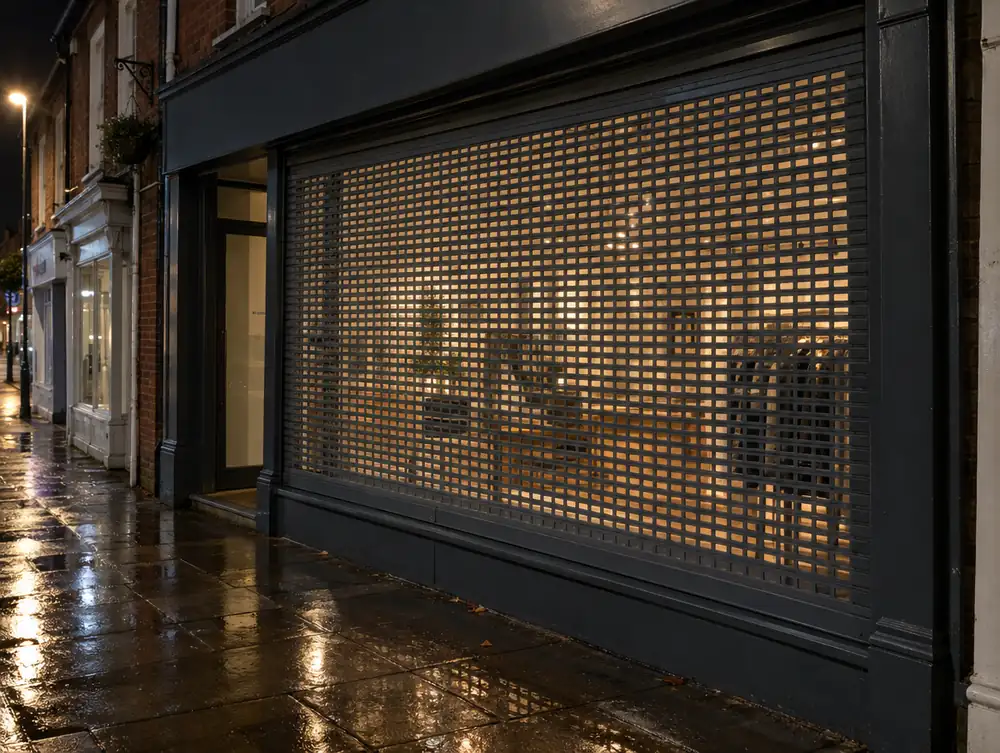
How would we approach perforated roller shutters for your Little Venice premises?
If the display goes dark overnight, the shutter will read as plain metal from the street. A low-level timer on the window lighting costs very little and keeps your Little Venice frontage looking open.
Where stock is high in value, a perforated shutter alone may not be enough. We would look at laminated glass in front, a rated curtain, and what your insurer expects, then specify the three together.
If your Little Venice unit is narrow, a central door can split a small window into two weak ones. Moving the door to one side gives you a single confident pane, provided the layout inside still works.
What should you budget for perforated roller shutters in Little Venice?
Guide price: £1,695 to £4,495 plus VAT per shutter. Materials, finish and the amount of drawing and coordination involved all move it, and your itemised quotation shows where the money goes on perforated roller shutters.
What consents could affect perforated roller shutters in Little Venice?
A true like-for-like replacement usually needs no planning permission in England, because the external appearance isn't materially affected. New materials, a different glass line or altered proportions usually do count as material, so for perforated roller shutters at premises in the Little Venice area, an application is then likely. The council confirms which side of that line a job falls on.
We confirm the position at survey, because a boundary or a special designation can change who handles the file, but applications from Little Venice premises normally go to Westminster City Council.
| Town | Little Venice |
|---|---|
| Area | Greater London |
| Postcode districts | NW8, W1H, W2, W9 |
| Planning authority | Westminster City Council |
| Building approval | Building Regulations (Approved Documents) |
| Distance from Great Barr | About 102 miles |
| Survey | Free for new work |
Does Westminster City Council publish shopfront guidance?
Yes, Shopfronts, Blinds and Signs - A Guide to their Design (1993). It tells applicants what the council expects from new and altered shopfronts. A few of the things it asks for:
- Roller shutters will not normally be given consent, and internally fitted brick-bond grilles are the preferred solution.
- Large internally lit box signs are generally inappropriate, while externally lit fascias and back-lit or halo-lit letters are accepted.
- Projecting signs need at least 2.6m clearance above the pavement and should sit at fascia level, centred on a pilaster.
Questions about perforated roller shutters in Little Venice
Can I keep my window display lit behind a shutter in Little Venice?
Yes, and we recommend it. A low-level light on a timer costs very little and lets the display read through the perforations overnight.
Can a perforated shutter match my other sites in Greater London?
Yes. Send us the colour reference and curtain type from an existing site, and we match them on the new one. The box and guides may differ, because each frontage has its own structure.
What controls can a shutter have?
A key switch, a wall button or a remote are the usual choices, each with a manual override. Many shops use a key switch at the door, so closing up needs someone present.
Does a new shopfront in the Little Venice area need Building Regulations approval?
Assume yes until building control says otherwise. England has no like-for-like exemption, though registered installers can self-certify replacement windows and doors in non-dwellings. That route doesn't cover structural glass, curtain walling or revolving doors.
Do I need listed building consent for a shopfront in the Little Venice area?
Usually yes, if the building is listed. In England the local planning authority decides, and Historic England is notified of Grade I and II* works and specified Grade II works. Like-for-like repair may not need consent, so ask the council before work starts.