Built-up letters, flat-cut metal or hand-painted timber can each work on fascias in Highgate, depending on the frontage and the brand. A scale drawing of the sign on your elevation makes the choice easy to judge.
Nothing gets ordered off the back of a survey in Highgate, because its job is to give us the numbers to draw and price from.
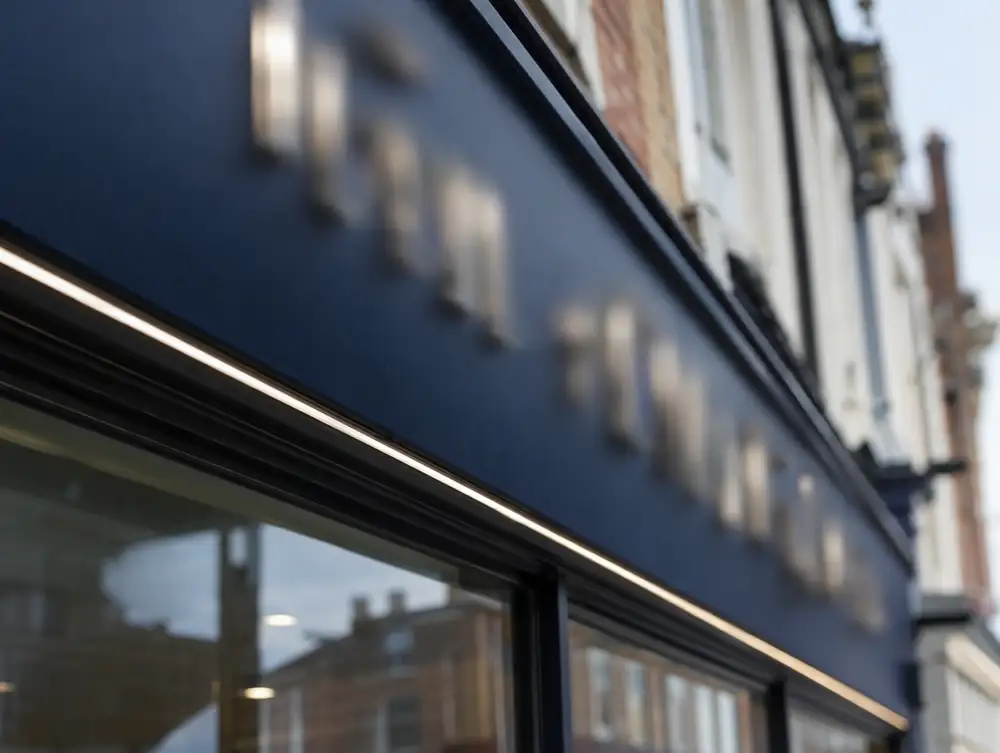
What goes into getting fascia signage right in Highgate?
For brands with strict guidelines, we turn logo artwork into cut files and check the smallest details at full size. If a thin stroke will not survive in metal, we suggest a small change before anything is made.
A deep fascia above a low shopfront can often be reduced on the drawing board. If your Highgate premises have one, we would show you a slimmer panel option, with the ceiling line behind it adjusted to suit.
A corner unit has two fronts to think about, and the return elevation often does as much selling as the main one. If that is your layout in Highgate, carry the fascia and glass line round the corner and treat both faces as one composition.
Which applications might fascia signage in Highgate involve?
A true like-for-like replacement usually needs no planning permission in England, because the external appearance isn't materially affected. New materials, a different glass line or altered proportions usually do count as material, so for fascia signage at premises in the Highgate area, an application is then likely. The council confirms which side of that line a job falls on.
Class 4B, England's class for lit signs, isn't available in conservation areas, Areas of Outstanding Natural Beauty, National Parks or the Broads, so a lit sign there normally needs advertisement consent. In an area of special control it is unavailable too, and Class 5 drops to a 3.6m top height, 0.3m letters and one-tenth of the building face up to 3.6m. Ask the council which designations cover premises in the Highgate area.
We confirm the position at survey, because a boundary or a special designation can change who handles the file, but applications from Highgate premises normally go to London Borough of Camden.
How much could fascia signage in Highgate cost you?
Until the survey is done, plan on £395 to £1,995 plus VAT per sign. Unusual sizes, fine detail and phased working push the figure up, while a simple brief and clear access keep it toward the lower end.
| Town | Highgate |
|---|---|
| Area | Greater London |
| Postcode districts | N19, N6, NW3, NW5 |
| Planning authority | London Borough of Camden |
| Building approval | Building Regulations (Approved Documents) |
| Distance from Great Barr | About 101 miles |
| Survey | Free for new work |
Does London Borough of Camden publish shopfront guidance?
Yes, Camden Planning Guidance: Design (Chapter 6: Shopfronts) (2021). It tells applicants what the council expects from new and altered shopfronts. A few of the things it asks for:
- Existing stall risers should be kept, and new ones should be at least 300mm high or reach the top of the pilaster base or door panel.
- Solid shutters are only acceptable in exceptional circumstances, and internal security measures are strongly encouraged.
- Uncoated shutters, galvanised steel, milled finishes and anodised aluminium are not acceptable finishes.
Questions about fascia signage in Highgate
Can a new fascia sign in Highgate be fitted on a closed day?
Yes, we can arrange that, or fit out of hours if that suits you better. Most fascia signs take about a day, so the work can often go into your quietest trading hours.
What if the fascia behind my old sign in Highgate is rotten?
We show you photographs and price the repair before going further. A short section of timber can often be spliced in, while a badly decayed fascia is better replaced with a new subframe.
Can a fascia sign in Highgate be lit later on?
Yes, if the sign is planned for it. Built-up letters can take halo lighting when the panel and cable route are prepared at the start, which costs far less than adapting them afterwards.
Does a new shopfront in the Highgate area need Building Regulations approval?
Assume yes until building control says otherwise. England has no like-for-like exemption, though registered installers can self-certify replacement windows and doors in non-dwellings. That route doesn't cover structural glass, curtain walling or revolving doors.
Do I need listed building consent for a shopfront in the Highgate area?
Usually yes, if the building is listed. In England the local planning authority decides, and Historic England is notified of Grade I and II* works and specified Grade II works. Like-for-like repair may not need consent, so ask the council before work starts.