Thinking about opening up your Highgate frontage? Start with where the stack will sit, because that one decision shapes the panel count, the track and the seating plan behind it.
Bring whatever you have to the survey in Highgate: brand guidelines, lease plans, old drawings or a photo of a frontage you admire.
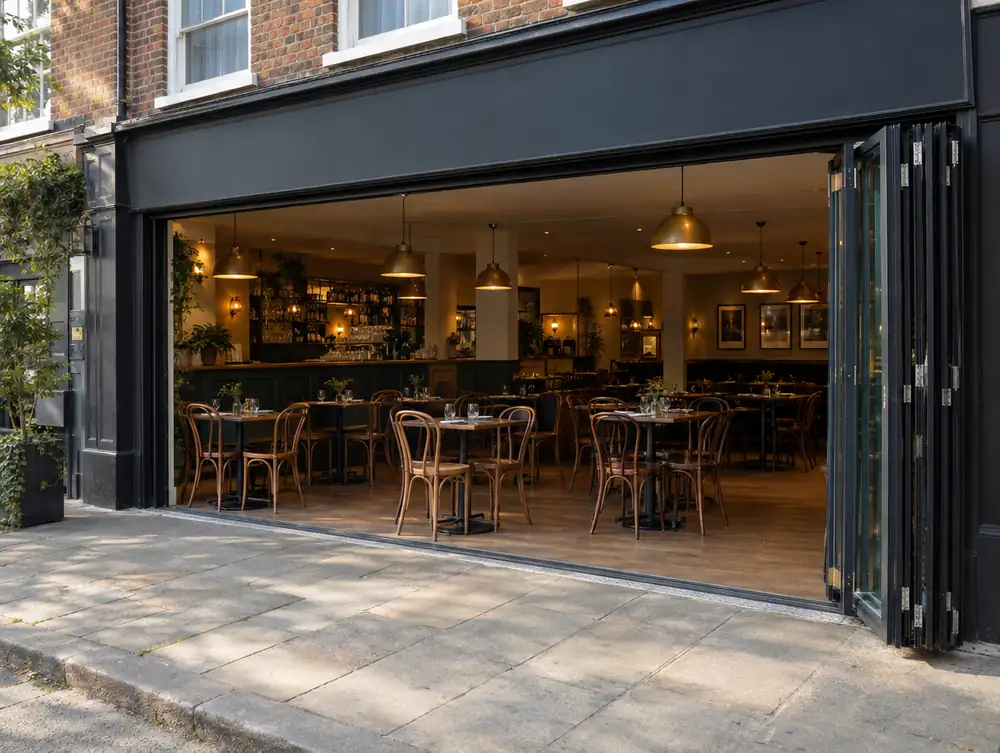
What makes bi-folding shopfronts work well on Highgate premises?
Bi-folds suit a two-stage fit at Highgate premises that trade late. We'd take the old front out and fix the frame during closed hours, then hang and adjust the panels the following night, with temporary boarding in between.
A deep recess can host a bi-fold set back from the street, which keeps the panels clear of passers-by and creates a sheltered pocket by the door. At Highgate premises with that depth, it's often the neatest layout.
Where the building has good brick or stone around the opening, set the frame back in the reveal so the masonry can be seen. On Highgate premises with a flat elevation, that deep reveal throws a shadow line that adds real depth in low sun.
How much should you set aside for bi-folding shopfronts in Highgate?
Guide price: £5,195 to £13,995 plus VAT for a typical opening. Materials, finish and the amount of drawing and coordination involved all move it, and your itemised quotation shows where the money goes on bi-folding shopfronts.
Could bi-folding shopfronts in Highgate need planning permission?
Security grilles and shutters are named in England's rules: installing or replacing one on a shopfront sits outside the shop permitted development rights. The frontage itself is treated the same way, so for bi-folding shopfronts at premises in the Highgate area, building work that materially affects the appearance needs planning permission. Confirm the position with the council before anything is ordered.
At survey we check how things stand for your building, although applications for planning permission or advertisement consent here normally go to London Borough of Camden.
| Town | Highgate |
|---|---|
| Area | Greater London |
| Postcode districts | N19, N6, NW3, NW5 |
| Planning authority | London Borough of Camden |
| Building approval | Building Regulations (Approved Documents) |
| Distance from Great Barr | About 101 miles |
| Survey | Free for new work |
Does London Borough of Camden publish shopfront guidance?
Yes, Camden Planning Guidance: Design (Chapter 6: Shopfronts) (2021). It tells applicants what the council expects from new and altered shopfronts. A few of the things it asks for:
- Existing stall risers should be kept, and new ones should be at least 300mm high or reach the top of the pilaster base or door panel.
- Solid shutters are only acceptable in exceptional circumstances, and internal security measures are strongly encouraged.
- Uncoated shutters, galvanised steel, milled finishes and anodised aluminium are not acceptable finishes.
Questions about bi-folding shopfronts in Highgate
Can my Highgate bi-fold be fitted around service?
Yes. Closed-day or out-of-hours fitting can be arranged to avoid your busiest sittings, and the job typically takes 2 to 4 days on site.
How many panels would my Highgate opening need?
It depends on the width and how you want the set to open. Most openings divide into leaves under 1m wide, and an odd number gives you a daily door, so we draw the options after the measure-up.
Who do I speak to about a bi-fold in Highgate?
Your named contact stays the same from the first visit to the final adjustment. Fitting is carried out by vetted teams working under S&K Glazing, travelling from Great Barr.
Do I need listed building consent for a shopfront in the Highgate area?
Usually yes, if the building is listed. In England the local planning authority decides, and Historic England is notified of Grade I and II* works and specified Grade II works. Like-for-like repair may not need consent, so ask the council before work starts.
Does the Equality Act apply to a shop entrance in the Highgate area?
Yes. The Equality Act 2010 applies in England, as across Great Britain, and it requires reasonable steps to remove, alter or avoid physical features that disadvantage disabled people. The duty is anticipatory, so it looks at disabled people generally, and a new Services Code replaced the 2011 Code on 5 August 2026.