Few businesses can shut for a week, so any time on site for illuminated signage in Clwyd is planned around the hours you trade. Closed-day or out-of-hours installation can be arranged.
Access gets as much attention as appearance at survey. Where a vehicle can stop, how long sections reach the opening and how the pavement stays safe for the public all shape the programme for illuminated signage in Clwyd.
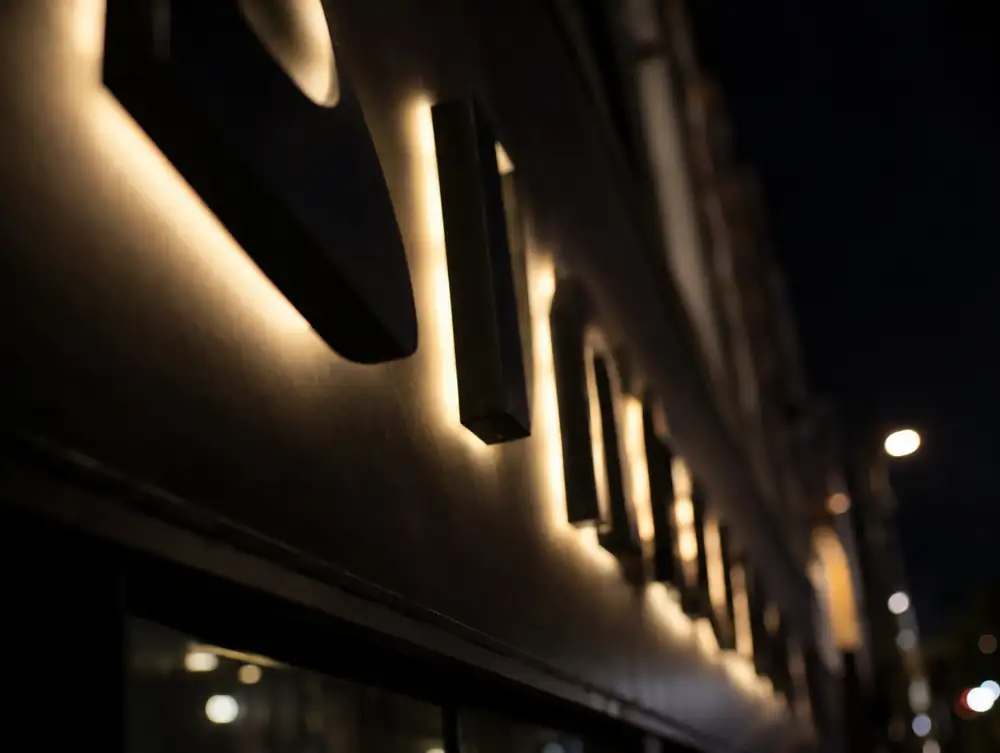
What should you settle before committing to illuminated signage in Clwyd?
Think first about when your customers arrive. For premises across Clwyd that trade into the evening, we design from the dusk view, since that is when the letters do their real work.
Colour temperature should match across a group. If you run premises at several addresses in Clwyd, we specify one white and one output, so sites opened years apart still look like one brand.
What consents apply to illuminated signage in Clwyd?
The existing rules still apply in Wales, because most of the Planning (Wales) Act 2026 is waiting for a commencement order. For illuminated signage at premises in the Clwyd area, building work that materially affects the external appearance needs planning permission, while a true like-for-like replacement usually doesn't. The council confirms the current position.
Signs in Wales still come under the 1992 Advertisement Regulations, with the classes set out in Schedule 3. At premises in the Clwyd area, an unlit fascia sign generally needs no application under Class 5 if it sits on a wall containing a shop window and tops out at 4.6m or the first-floor sill if that is lower. Ask the council about letter sizes, and bear in mind that displaying a sign without consent is a criminal offence.
How much does illuminated signage cost in Clwyd?
We would budget £895 to £3,995 plus VAT per sign. Scope sets most of the figure, so a clear brief at the start does more for the budget than any later change of detail.
| Area | Clwyd |
|---|---|
| Nation | Wales |
| Towns covered | 14 |
| Main town | Wrexham |
| Planning regime | Wales: TCPA 1990 and the 1992 Advertisement Regulations |
| Building approval | Building Regulations (Approved Documents for Wales) |
| Survey | Free for new work, from our Great Barr base |
Does Conwy County Borough Council publish shopfront guidance?
Yes, LDP36: Shop front design (2017). It tells applicants what the council expects from new and altered shopfronts. A few of the things it asks for:
- Stallriser height should not normally exceed 20% of the overall shopfront height.
- Fascia depth is restricted to the depth of the console, or one-fifth of the distance from cornice to pavement where there are no consoles.
- Illuminated box signs and vinyl or acrylic signs are not permitted in conservation areas or on historic buildings, with halo-lit or individually lit letters preferred.
Questions about illuminated signage in Clwyd
How disruptive is fitting a lit sign in Clwyd?
Very little, as a rule. Fitting usually takes one to two days from a tower or platform, and any cable work inside the shop can be done outside trading hours.
Which light colour suits premises near Wrexham?
Warm white around 3000K suits most timber, brick and hospitality frontages, and 4000K suits cooler, metallic brands. We look at the fascia and interior lighting together, because a sign that clashes with the shop behind it looks like an afterthought.
Can you test a lit letter on my premises in Clwyd before ordering?
Yes, where the job warrants it. A sample letter held against your fascia at dusk tells you more than a visual, particularly for halo lighting on a dark finish.
Can a roller shutter go on a shop in the Clwyd area without planning permission?
Usually not in Wales. Part 42 of the 1995 Order, as inserted in 2014, excludes installing or replacing a security grill or shutter on a shopfront, so the rights for shops don't help. The only way to avoid an application is work that doesn't materially affect the appearance, and the council confirms that.
Can a shop fire exit in the Clwyd area use a sliding door?
No, a dedicated fire exit can't be a sliding or revolving door. In Wales, article 14(2) of the Regulatory Reform (Fire Safety) Order 2005 also says fire exit doors must open in the direction of escape and can't be locked against immediate use. The responsible person holds that duty, normally the employer or whoever controls the premises for a business, otherwise the owner.