Looking for a front with more character on your Mortlake premises? A painted timber frontage, built up in layers and proportioned to the building, has a warmth that reads from across the street.
Surveys for Mortlake are booked with you directly. Tell us your quieter days and we'll work around them.
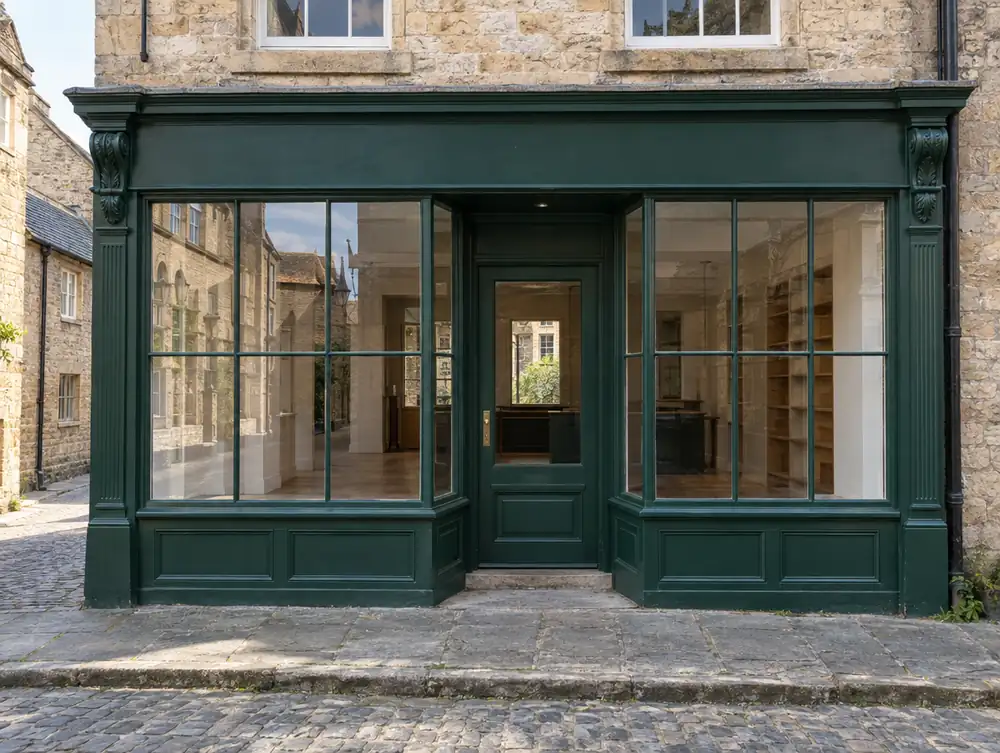
Where should you begin with timber shopfronts in Mortlake?
Where a landlord in Mortlake has set rules for materials or colour, timber is usually an easy conversation. We'd prepare a drawing and paint reference for approval, and adjust the mouldings if the terms ask for something plainer.
A corner plot gives a timber front two faces and one chance to get the turn right. For Mortlake premises on a corner, we'd use a pilaster or a canted bay at the angle, so the cornice wraps round without a clumsy mitre.
Where a fascia has crept down over the years, lifting it back to its original line can add real height to the glass. Check what sits behind it first at Mortlake premises, since a shutter box or old beam may set the limit.
What price should you expect for timber shopfronts in Mortlake?
Until the survey is done, plan on £3,995 to £13,995 plus VAT for a typical frontage. Unusual sizes, fine detail and phased working push the figure up, while a simple brief and clear access keep it toward the lower end.
What sign-off might you need for timber shopfronts in Mortlake?
England has no permitted development route for changing a shopfront. Part 7 Class A of the General Permitted Development Order 2015 excludes creating, altering or replacing one, and it allows no alterations at all on article 2(3) land. That leaves two outcomes for timber shopfronts at premises in the Mortlake area: a planning application, or work that doesn't materially affect the external appearance.
We confirm the position at survey, because a boundary or a special designation can change who handles the file, but applications from Mortlake premises normally go to London Borough of Richmond upon Thames.
| Town | Mortlake |
|---|---|
| Area | Greater London |
| Postcode districts | SW13, SW14, TW9, W4 |
| Planning authority | London Borough of Richmond upon Thames |
| Building approval | Building Regulations (Approved Documents) |
| Distance from Great Barr | About 102 miles |
| Survey | Free for new work |
Does London Borough of Richmond upon Thames publish shopfront guidance?
Yes, Shopfronts: Supplementary Planning Document (2010). It tells applicants what the council expects from new and altered shopfronts. A few of the things it asks for:
- The fascia should be no deeper than the cornice and architrave combined, and no more than one-fifth of total shopfront height.
- External roller shutters are unlikely to be permitted, and internal grilles are the only acceptable security form in conservation areas and on listed buildings.
- Internally lit box fascia signs will usually be resisted, with externally lit fascias generally preferred.
Questions about timber shopfronts in Mortlake
Do you make the joinery for Mortlake shops to order?
Yes. Every length is made to the signed-off drawings for your opening, then brought to Mortlake from Great Barr by vetted teams working under S&K Glazing.
What should I budget for looking after a timber front in Mortlake?
A repaint every 5 to 7 years, plus a yearly wash and touch-up of the cills. Door gear needs checking too, since seasonal movement can throw a door out of line.
Will timber suffer on my Mortlake frontage if it gets a lot of rain?
Not if the details are right. Sloped cills, sealed end grain and plinth blocks keep water moving, and the paint system then only has to deal with the weather, not trapped damp.
Do I need listed building consent for a shopfront in the Mortlake area?
Usually yes, if the building is listed. In England the local planning authority decides, and Historic England is notified of Grade I and II* works and specified Grade II works. Like-for-like repair may not need consent, so ask the council before work starts.
Does the Equality Act apply to a shop entrance in the Mortlake area?
Yes. The Equality Act 2010 applies in England, as across Great Britain, and it requires reasonable steps to remove, alter or avoid physical features that disadvantage disabled people. The duty is anticipatory, so it looks at disabled people generally, and a new Services Code replaced the 2011 Code on 5 August 2026.