Thinking of taking the frames off your Bow frontage? Toughened glass from floor to fascia works when the joints are planned, the head is stiff and the edges are hidden, and that thinking is done before anything is ordered.
Nothing gets ordered off the back of a survey in Bow, because its job is to give us the numbers to draw and price from.
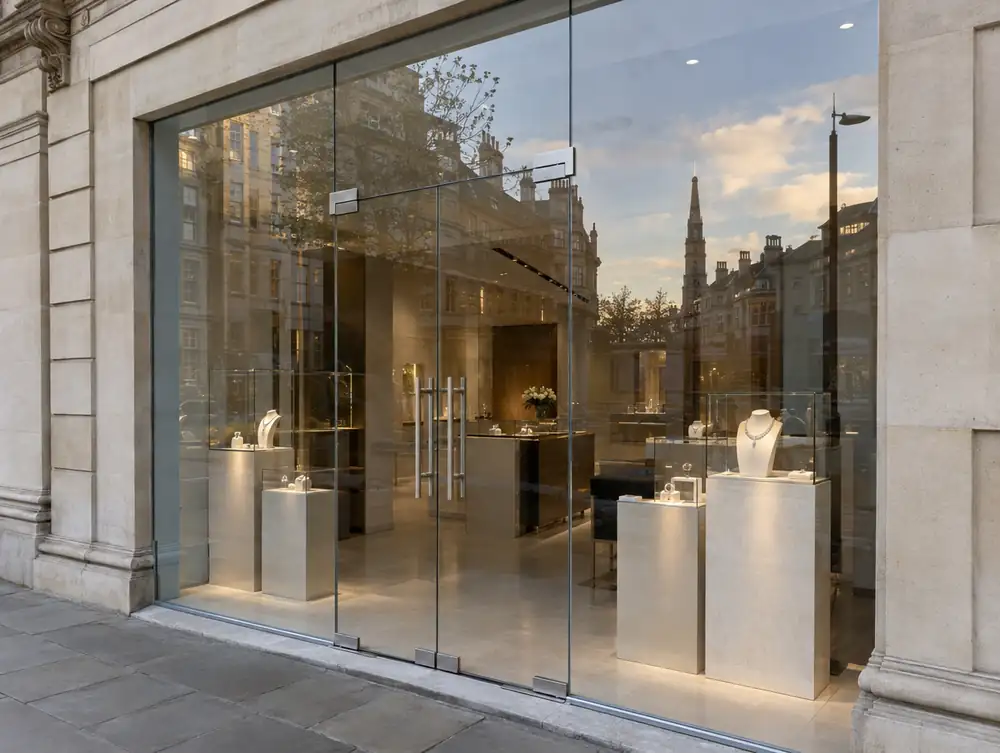
What makes frameless glass shopfronts work well on Bow premises?
A recessed entrance gives frameless glass somewhere to perform. At Bow premises with a deep lobby, we'd carry glass back along the returns, light the soffit and run one floor finish from the pavement line into the shop.
If your Bow landlord wants the front reinstated at lease end, frameless glass needs thought now. We'd record the existing front in the drawings and keep the channels simple, so returning the opening later stays a straightforward job.
A corner unit has two fronts to think about, and the return elevation often does as much selling as the main one. If that is your layout in Bow, carry the fascia and glass line round the corner and treat both faces as one composition.
How much should you set aside for frameless glass shopfronts in Bow?
Until the survey is done, plan on £4,995 to £15,995 plus VAT for a typical frontage. Unusual sizes, fine detail and phased working push the figure up, while a simple brief and clear access keep it toward the lower end.
Could frameless glass shopfronts in Bow need planning permission?
England has no permitted development route for changing a shopfront. Part 7 Class A of the General Permitted Development Order 2015 excludes creating, altering or replacing one, and it allows no alterations at all on article 2(3) land. That leaves two outcomes for frameless glass shopfronts at premises in the Bow area: a planning application, or work that doesn't materially affect the external appearance.
We confirm the position at survey, because a boundary or a special designation can change who handles the file, but applications from Bow premises normally go to London Borough of Tower Hamlets.
| Town | Bow |
|---|---|
| Area | Greater London |
| Postcode districts | E14, E15, E3, E9 |
| Planning authority | London Borough of Tower Hamlets |
| Building approval | Building Regulations (Approved Documents) |
| Distance from Great Barr | About 107 miles |
| Survey | Free for new work |
Does London Borough of Tower Hamlets publish shopfront guidance?
Yes, Shopfronts and Roller Shutter Grilles. It tells applicants what the council expects from new and altered shopfronts. A few of the things it asks for:
- Stallrisers are always required on traditional shopfronts.
- Fascias should normally be no more than 500mm deep and no higher than ground floor level.
- External roller shutter boxes will not be permitted, and shutters should wherever possible be an integral feature of the shopfront.
Questions about frameless glass shopfronts in Bow
Can frameless glass go above a cellar in Bow?
Often, yes, with some redesign. A cellar or thin slab can rule out a recessed channel, so we'd clamp the glass to a strengthened threshold or add a low plinth to hold it.
Which glass should I choose for premises in Greater London?
Clear toughened is the starting point, with low-iron for a whiter look and toughened laminated where you want the pane to stay put after a break. The right one depends on your stock, your street and your insurer.
Can I see how the joints will look on my Bow front?
Yes. The scale drawings show every joint and door line, and you sign off the layout before the glass is ordered. If the joint colour matters, ask at the survey and we'll bring samples.
Do I need planning permission to change a shopfront in the Bow area?
Usually yes, if the work materially affects the building's external appearance. England's shop permitted development rights exclude creating, altering or replacing a shopfront, so there is no shortcut. A true like-for-like replacement usually needs no application, and the council confirms the position.
Do I need listed building consent for a shopfront in the Bow area?
Usually yes, if the building is listed. In England the local planning authority decides, and Historic England is notified of Grade I and II* works and specified Grade II works. Like-for-like repair may not need consent, so ask the council before work starts.