Looking for a front with more character on your Bow premises? A painted timber frontage, built up in layers and proportioned to the building, has a warmth that reads from across the street.
We measure your Bow opening in person, at a time agreed with you first, so the visit fits around your trading.
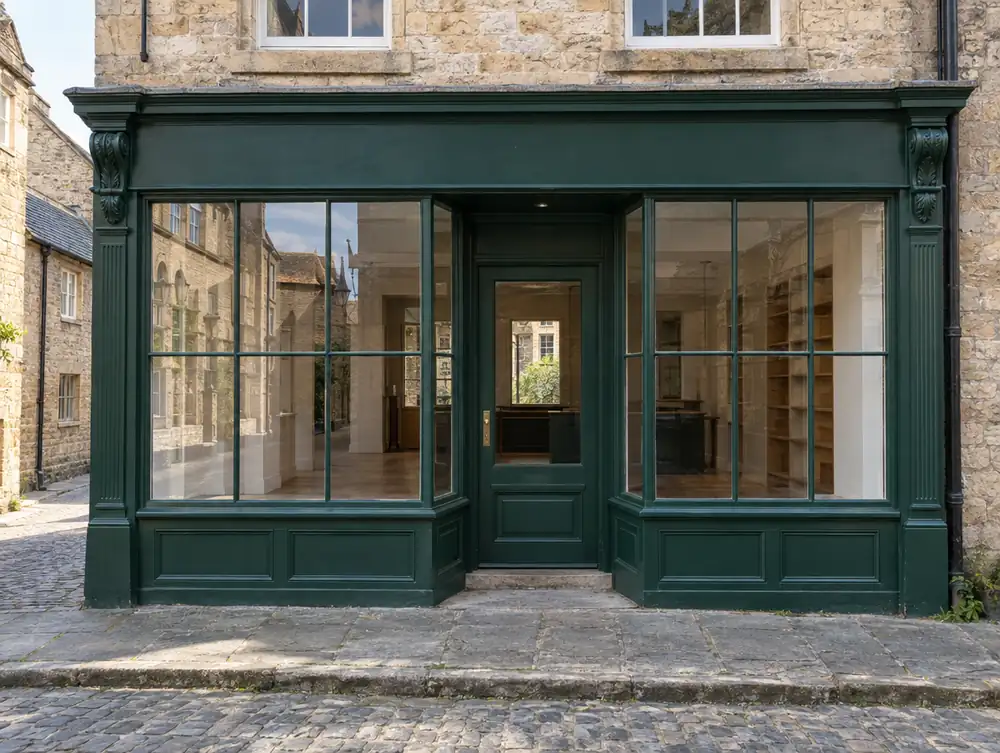
Where should you begin with timber shopfronts in Bow?
In a parade of mixed fronts in Bow, painted timber can lift a unit without shouting. We'd take the height of the neighbouring cills and fascias, then let the depth of the mouldings and a considered colour do the talking.
Timber fits a night programme better than you'd think, since most of the joinery is made elsewhere. For a unit in Bow that can't close by day, we'd fit the frame in stages at night and leave painting until the end, once the dust has gone.
If your Bow unit is narrow, a central door can split a small window into two weak ones. Moving the door to one side gives you a single confident pane, provided the layout inside still works.
What sign-off might you need for timber shopfronts in Bow?
England has no permitted development route for changing a shopfront. Part 7 Class A of the General Permitted Development Order 2015 excludes creating, altering or replacing one, and it allows no alterations at all on article 2(3) land. That leaves two outcomes for timber shopfronts at premises in the Bow area: a planning application, or work that doesn't materially affect the external appearance.
For Bow, the usual route for planning and advert applications is through London Borough of Tower Hamlets, and we confirm that when we visit.
What price should you expect for timber shopfronts in Bow?
Allow £3,995 to £13,995 plus VAT for a typical frontage. Size and specification set most of that figure for timber shopfronts, and the rest depends on what the survey finds on site.
| Town | Bow |
|---|---|
| Area | Greater London |
| Postcode districts | E14, E15, E3, E9 |
| Planning authority | London Borough of Tower Hamlets |
| Building approval | Building Regulations (Approved Documents) |
| Distance from Great Barr | About 107 miles |
| Survey | Free for new work |
Does London Borough of Tower Hamlets publish shopfront guidance?
Yes, Shopfronts and Roller Shutter Grilles. It tells applicants what the council expects from new and altered shopfronts. A few of the things it asks for:
- Stallrisers are always required on traditional shopfronts.
- Fascias should normally be no more than 500mm deep and no higher than ground floor level.
- External roller shutter boxes will not be permitted, and shutters should wherever possible be an integral feature of the shopfront.
Questions about timber shopfronts in Bow
Can a timber front take a modern sign in Bow?
Yes. Hand-painted letters suit a timber fascia well, and raised letters or a concealed trough light work too. We draw the sign and the joinery together, so the fixings don't cut through a moulding.
How much disruption will a timber front cause in my Bow shop?
Expect more time on site than an aluminium front, typically 3 to 7 days with the painting. Closed-day or out-of-hours fitting can be arranged, and the opening stays boarded and secure between stages.
Can you copy a timber shopfront I've seen in Greater London?
We can work from your photo and borrow what makes it succeed, including proportions, moulding sizes and colour. The front is then drawn to your own Bow opening.
Does the Equality Act apply to a shop entrance in the Bow area?
Yes. The Equality Act 2010 applies in England, as across Great Britain, and it requires reasonable steps to remove, alter or avoid physical features that disadvantage disabled people. The duty is anticipatory, so it looks at disabled people generally, and a new Services Code replaced the 2011 Code on 5 August 2026.
Do I need planning permission to change a shopfront in the Bow area?
Usually yes, if the work materially affects the building's external appearance. England's shop permitted development rights exclude creating, altering or replacing a shopfront, so there is no shortcut. A true like-for-like replacement usually needs no application, and the council confirms the position.