We make timber shopfronts for Blackwall premises, from plain painted frames to full cornice and console fronts. Every one starts with a measured survey and scale drawings.
A survey in Blackwall usually starts outside, looking at the whole elevation before any tape comes out, because the frontage has to answer the building above it.
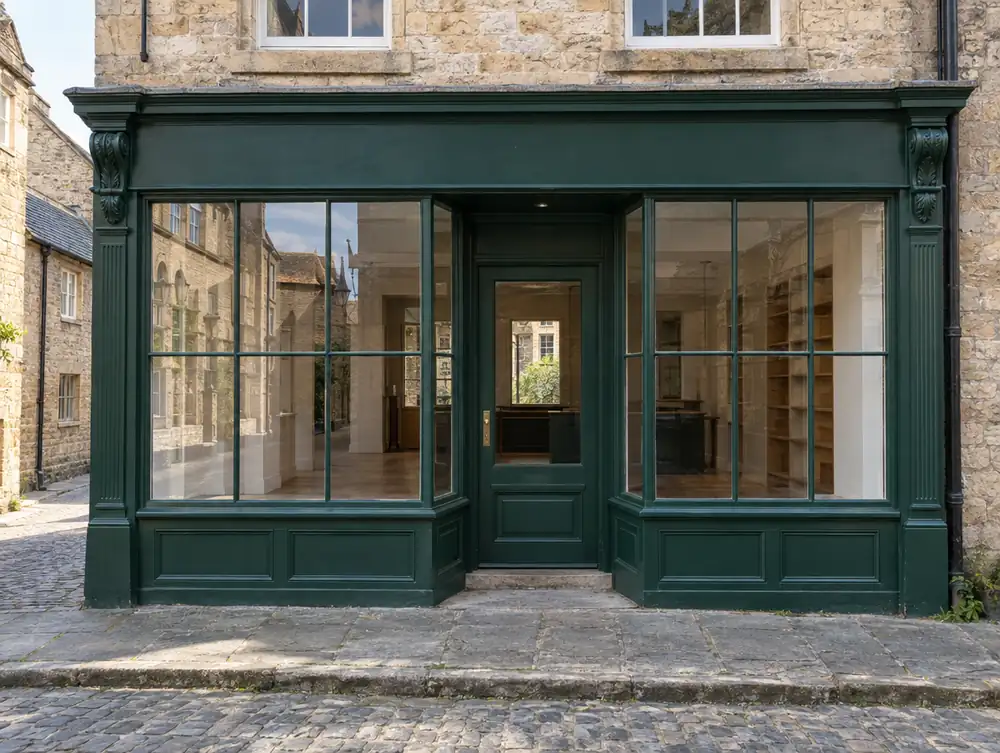
How would we approach timber shopfronts for your Blackwall premises?
A south or west-facing Blackwall frontage is hard on paint. We'd steer you toward a lighter colour or a more stable timber, and if the brand needs a dark finish, we'd plan a shorter repaint interval from the outset.
Timber fits a night programme better than you'd think, since most of the joinery is made elsewhere. For a unit in Blackwall that can't close by day, we'd fit the frame in stages at night and leave painting until the end, once the dust has gone.
On a north-facing frontage the glass stays free of glare, but the interior can look dim from the street, so lighting needs to sit closer to the window. If your Blackwall premises face south, the problem flips to reflections by day and fading stock.
What consents could affect timber shopfronts in Blackwall?
A true like-for-like replacement usually needs no planning permission in England, because the external appearance isn't materially affected. New materials, a different glass line or altered proportions usually do count as material, so for timber shopfronts at premises in the Blackwall area, an application is then likely. The council confirms which side of that line a job falls on.
For Blackwall, the usual route for planning and advert applications is through London Borough of Tower Hamlets, and we confirm that when we visit.
What should you budget for timber shopfronts in Blackwall?
As a working budget, use £3,995 to £13,995 plus VAT for a typical frontage. Your place inside that range for timber shopfronts depends mostly on how much of the existing frontage can stay and how much has to be put right first.
| Town | Blackwall |
|---|---|
| Area | Greater London |
| Postcode districts | E13, E14, E16, E3 |
| Planning authority | London Borough of Tower Hamlets |
| Building approval | Building Regulations (Approved Documents) |
| Distance from Great Barr | About 108 miles |
| Survey | Free for new work |
Does London Borough of Tower Hamlets publish shopfront guidance?
Yes, Shopfronts and Roller Shutter Grilles. It tells applicants what the council expects from new and altered shopfronts. A few of the things it asks for:
- Stallrisers are always required on traditional shopfronts.
- Fascias should normally be no more than 500mm deep and no higher than ground floor level.
- External roller shutter boxes will not be permitted, and shutters should wherever possible be an integral feature of the shopfront.
Questions about timber shopfronts in Blackwall
What should I budget for looking after a timber front in Blackwall?
A repaint every 5 to 7 years, plus a yearly wash and touch-up of the cills. Door gear needs checking too, since seasonal movement can throw a door out of line.
Do you make the joinery for Blackwall shops to order?
Yes. Every length is made to the signed-off drawings for your opening, then brought to Blackwall from Great Barr by vetted teams working under S&K Glazing.
Will timber suffer on my Blackwall frontage if it gets a lot of rain?
Not if the details are right. Sloped cills, sealed end grain and plinth blocks keep water moving, and the paint system then only has to deal with the weather, not trapped damp.
Do roller shutters need planning permission in the Blackwall area?
Usually yes. Installing or replacing a security grill or shutter on a shopfront is expressly outside England's shop permitted development rights, so the only way to avoid an application is work that doesn't materially affect the appearance. Ask the council before ordering.
Do I need listed building consent for a shopfront in the Blackwall area?
Usually yes, if the building is listed. In England the local planning authority decides, and Historic England is notified of Grade I and II* works and specified Grade II works. Like-for-like repair may not need consent, so ask the council before work starts.