We work UK-wide from Great Barr in Birmingham, so if your town isn't listed under Tyne and Wear, send the address anyway and we'll arrange a survey.
You can check a guide price before anyone visits, using the bands on our prices page or the guide price tool. The firm figure for Tyne and Wear premises comes after the measured survey, in a written, itemised quotation valid for 90 days.
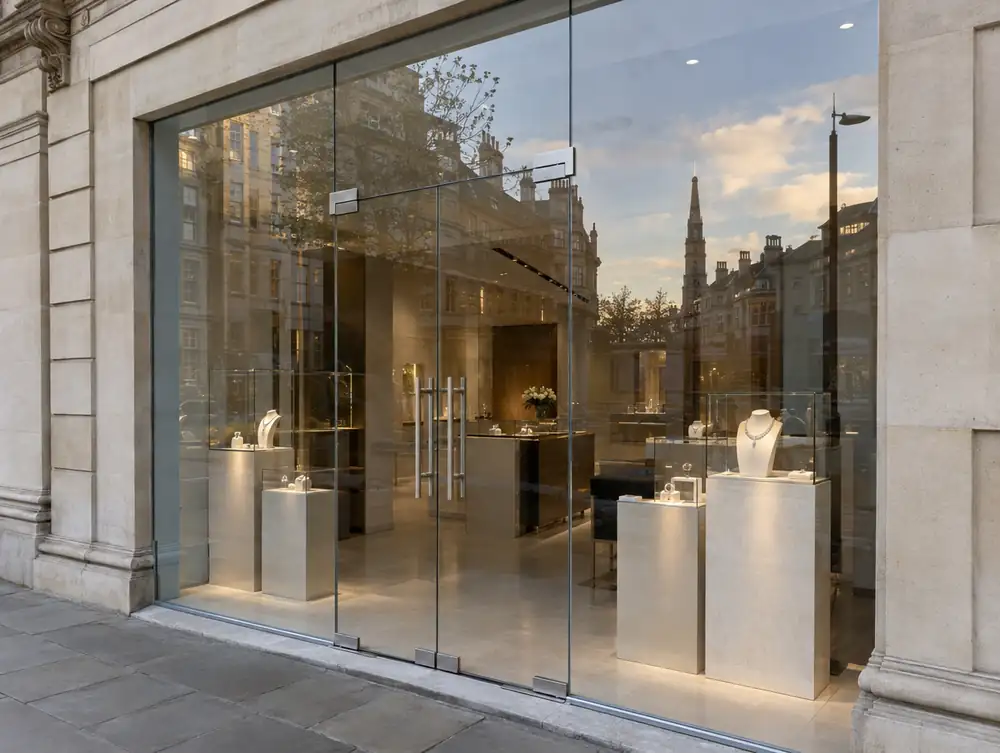
What consents apply to shopfronts in Tyne and Wear?
England has no permitted development route for changing a shopfront. Part 7 Class A of the General Permitted Development Order 2015 excludes creating, altering or replacing one, and it allows no alterations at all on article 2(3) land. That leaves two outcomes for shopfront work at premises in the Tyne and Wear area: a planning application, or work that doesn't materially affect the external appearance.
Lighting moves a sign out of Class 5 in England, because that class allows illumination only for medical-type notices. Class 4B then applies at premises in the Tyne and Wear area: halo or character-only lighting, static, with the lowest part at least 2.5m up. Brightness is capped at 600 cd/m² on signs up to 10m² and 300 cd/m² above that, and anything outside these limits needs advertisement consent.
Which rules apply to buildings in Tyne and Wear?
Historic England warns that heavier glass can affect a shopfront's structure, which matters on a listed frontage in the Tyne and Wear area if thicker glazing is planned. A change like that usually needs listed building consent from the local planning authority in England. On Grade I and II* buildings, Historic England is also told about the works.
For a public entrance in the Tyne and Wear area, the Building Regulations guidance in England is Approved Document M Volume 2. It asks for a level threshold, or 15mm at most with any upstand over 5mm chamfered, plus a 1500mm by 1500mm landing. Clear door width is 1000mm on a new door and 775mm on an existing one.
| Area | Tyne and Wear |
|---|---|
| Nation | England |
| Towns covered | 20 |
| Main town | Newcastle upon Tyne |
| Planning regime | England: TCPA 1990 and the 2007 Advertisement Regulations |
| Building approval | Building Regulations (Approved Documents) |
Does Newcastle City Council publish shopfront guidance?
Yes, Shopfronts in the historic environment (2011). It tells applicants what the council expects from new and altered shopfronts. A few of the things it asks for:
- Fascias should generally take up no more than 20% of the shopfront height, with lettering no more than two-thirds of the fascia height.
- Solid external roller shutters are treated as harmful to appearance, with internal lattice grilles offered as a good alternative.
- No shopfront sign should be internally lit, and whole plastic fascias are not acceptable.
What can we fit in Tyne and Wear?
- Aluminium shopfronts
from £2,495 plus VAT - Frameless glass shopfronts
from £4,995 plus VAT - Timber shopfronts
from £3,995 plus VAT - Bi-folding shopfronts
from £5,195 plus VAT - Heritage shopfronts
from £8,495 plus VAT - Bronze and metal shopfronts
from £7,995 plus VAT - Curved glass shopfronts
from £6,995 plus VAT - Automatic sliding doors
from £3,895 plus VAT - Frameless glass doors
from £1,495 plus VAT - Revolving doors
from £19,995 plus VAT - Accessible entrances
from £995 plus VAT - Curtain walling
from £550 plus VAT per m² - Structural glazing
from £950 plus VAT per m² - Stallrisers and cladding
from £195 plus VAT per m² - Fascia signage
from £395 plus VAT - Illuminated signage
from £895 plus VAT - Projecting signs
from £395 plus VAT - Canopies and awnings
from £1,495 plus VAT - Perforated roller shutters
from £1,695 plus VAT - Security glazing
from £195 plus VAT per m² - Shopfront design service
from £495 plus VAT - Planning and consents
from £395 plus VAT - Multi-site rollouts
Priced per estate - Shopfront refurbishment
from £1,995 plus VAT
Questions about shopfronts in Tyne and Wear
Do you offer repairs in Tyne and Wear?
Repairs run as paid call-outs, separate from surveys for new work. A shopfront repair call-out is £165 plus VAT for attendance and the first hour, so check with us that your address is covered before you book.
Are your prices different in Tyne and Wear?
No, the guide bands are the same across the UK. What changes a firm quotation is the building itself: the size of the opening, the access and what the survey finds, more than the postcode.
Can a tenant in Tyne and Wear commission a new shopfront?
Yes, tenants can commission us directly. Your landlord will probably want to see the proposal first, so our scale drawings are prepared to be passed on.
Does a shop sign in the Tyne and Wear area need advertisement consent?
Not always. In England, an unlit sign within Class 5 of the 2007 Advertisement Regulations generally needs no application, and neither does a lit sign within Class 4B. Anything outside those classes needs consent, and Class 4B isn't available in conservation areas, so check before ordering.
Do I need planning permission to change a shopfront in the Tyne and Wear area?
Usually yes, if the work materially affects the building's external appearance. England's shop permitted development rights exclude creating, altering or replacing a shopfront, so there is no shortcut. A true like-for-like replacement usually needs no application, and the council confirms the position.
Does the Equality Act apply to a shop entrance in the Tyne and Wear area?
Yes. The Equality Act 2010 applies in England, as across Great Britain, and it requires reasonable steps to remove, alter or avoid physical features that disadvantage disabled people. The duty is anticipatory, so it looks at disabled people generally, and a new Services Code replaced the 2011 Code on 5 August 2026.