For premises in and around Cambridge, and elsewhere in Cambridgeshire, we offer design-led shopfronts with no shortcuts on measuring. Nothing is made until you have signed off the dimensions.
Trading carries on wherever it can during the work. Installation can be arranged for closed days or out of hours, and the sequence on site is planned with overnight security in mind.
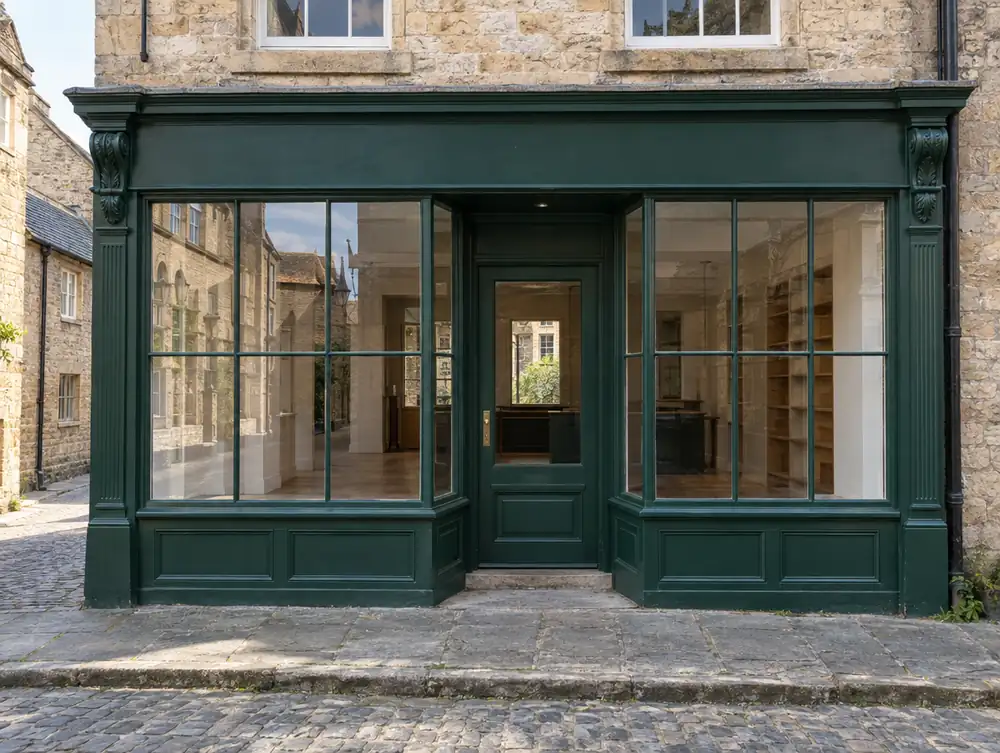
What consents apply to shopfronts in Cambridgeshire?
Security grilles and shutters are named in England's rules: installing or replacing one on a shopfront sits outside the shop permitted development rights. The frontage itself is treated the same way, so for shopfront work at premises in the Cambridgeshire area, building work that materially affects the appearance needs planning permission. Confirm the position with the council before anything is ordered.
Class 4B, England's class for lit signs, isn't available in conservation areas, Areas of Outstanding Natural Beauty, National Parks or the Broads, so a lit sign there normally needs advertisement consent. In an area of special control it is unavailable too, and Class 5 drops to a 3.6m top height, 0.3m letters and one-tenth of the building face up to 3.6m. Ask the council which designations cover premises in the Cambridgeshire area.
Which rules apply to buildings in Cambridgeshire?
Historic England warns that heavier glass can affect a shopfront's structure, which matters on a listed frontage in the Cambridgeshire area if thicker glazing is planned. A change like that usually needs listed building consent from the local planning authority in England. On Grade I and II* buildings, Historic England is also told about the works.
For a public entrance in the Cambridgeshire area, the Building Regulations guidance in England is Approved Document M Volume 2. It asks for a level threshold, or 15mm at most with any upstand over 5mm chamfered, plus a 1500mm by 1500mm landing. Clear door width is 1000mm on a new door and 775mm on an existing one.
| Area | Cambridgeshire |
|---|---|
| Nation | England |
| Towns covered | 12 |
| Main town | Cambridge |
| Planning regime | England: TCPA 1990 and the 2007 Advertisement Regulations |
| Building approval | Building Regulations (Approved Documents) |
Does Greater Cambridge publish shopfront guidance?
Yes, Appendix I: Shopfront guidance (Draft Greater Cambridge Local Plan). It tells applicants what the council expects from new and altered shopfronts. It is a draft, so check its status with the council before you rely on it. A few of the things it asks for:
- Original stallriser features should be kept and repaired unless beyond reasonable repair.
- Solid external roller shutters would only be approved if no other protection is adequate, and roller grilles need a case supported by police and insurer letters.
- Illuminated box fascias are not acceptable, and spotlights should be limited to two on most shopfronts or three on very wide ones.
What can we fit in Cambridgeshire?
- Aluminium shopfronts
from £2,495 plus VAT - Frameless glass shopfronts
from £4,995 plus VAT - Timber shopfronts
from £3,995 plus VAT - Bi-folding shopfronts
from £5,195 plus VAT - Heritage shopfronts
from £8,495 plus VAT - Bronze and metal shopfronts
from £7,995 plus VAT - Curved glass shopfronts
from £6,995 plus VAT - Automatic sliding doors
from £3,895 plus VAT - Frameless glass doors
from £1,495 plus VAT - Revolving doors
from £19,995 plus VAT - Accessible entrances
from £995 plus VAT - Curtain walling
from £550 plus VAT per m² - Structural glazing
from £950 plus VAT per m² - Stallrisers and cladding
from £195 plus VAT per m² - Fascia signage
from £395 plus VAT - Illuminated signage
from £895 plus VAT - Projecting signs
from £395 plus VAT - Canopies and awnings
from £1,495 plus VAT - Perforated roller shutters
from £1,695 plus VAT - Security glazing
from £195 plus VAT per m² - Shopfront design service
from £495 plus VAT - Planning and consents
from £395 plus VAT - Multi-site rollouts
Priced per estate - Shopfront refurbishment
from £1,995 plus VAT
Questions about shopfronts in Cambridgeshire
Are your prices different in Cambridgeshire?
No, the guide bands are the same across the UK. What changes a firm quotation is the building itself: the size of the opening, the access and what the survey finds, more than the postcode.
How early should we talk to you about premises in Cambridgeshire?
Earlier than you think, ideally before you fix an opening date. Making typically takes 2 to 4 weeks and site work 1 to 5 days, and that comes after survey, drawings and sign-off.
Can you match an existing frontage in Cambridgeshire?
Usually, yes. Colours, profiles and proportions can all be matched closely once we have measured them, although an aged finish rarely matches a new one on day one, so we show you samples first.
Do I need planning permission to change a shopfront in the Cambridgeshire area?
Usually yes, if the work materially affects the building's external appearance. England's shop permitted development rights exclude creating, altering or replacing a shopfront, so there is no shortcut. A true like-for-like replacement usually needs no application, and the council confirms the position.
What rules apply to a fire exit door through a shopfront in the Cambridgeshire area?
It must open in the direction of escape and can't be locked against immediate use, and a dedicated fire exit can't be a sliding or revolving door. In England that comes from article 14(2) of the Regulatory Reform (Fire Safety) Order 2005, and the duty sits with the responsible person, normally the employer or whoever controls the premises for a business, otherwise the owner. An outward door can clash with section 153 of the Highways Act 1980 where it opens onto the footway, so raise it early.
Does a new shopfront in the Cambridgeshire area need Building Regulations approval?
Assume yes until building control says otherwise. England has no like-for-like exemption, though registered installers can self-certify replacement windows and doors in non-dwellings. That route doesn't cover structural glass, curtain walling or revolving doors.